The Wrong Genre Circus
How This Circus Escaped
A true story. Not a pitch.
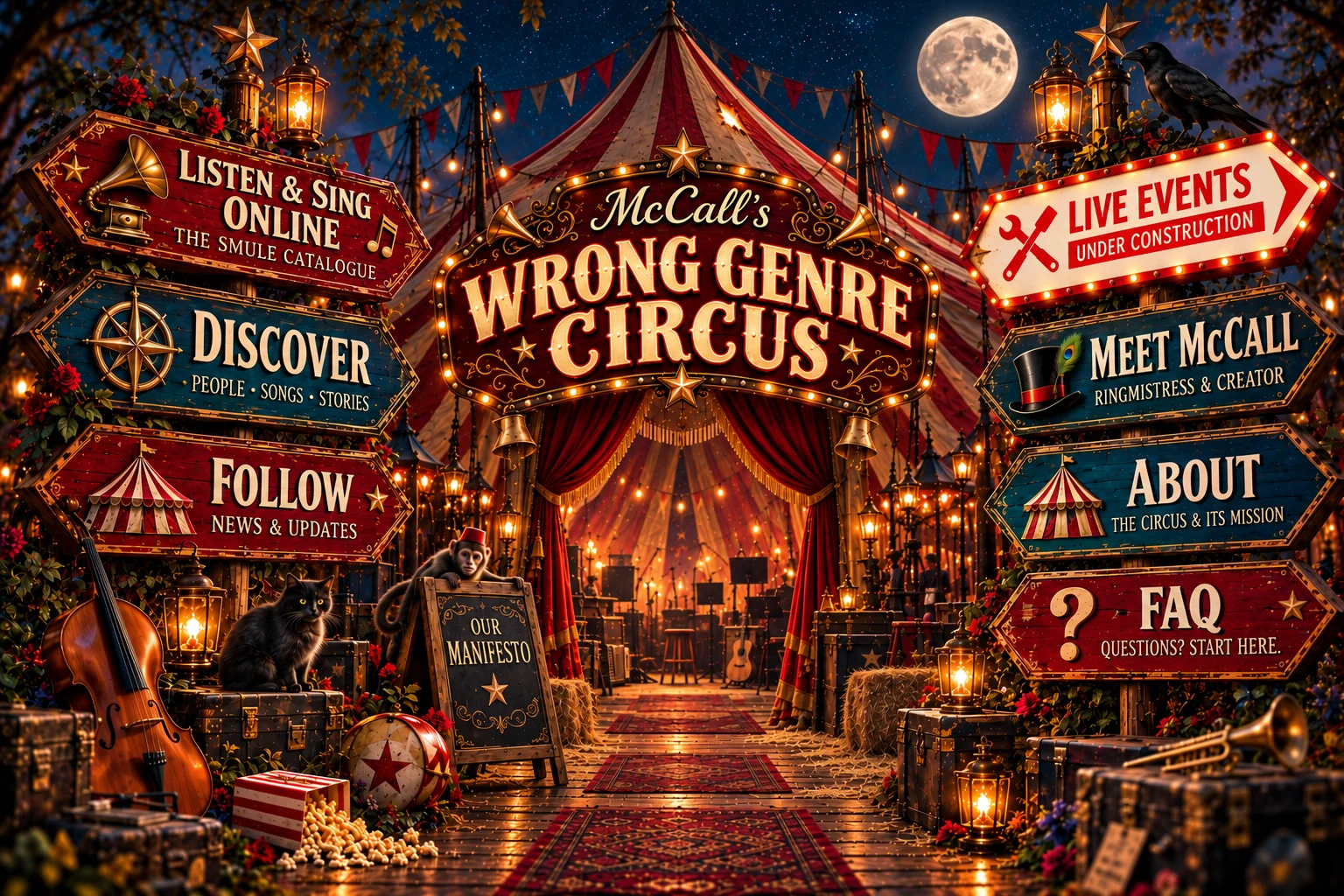
The origin
For almost a decade I had VIP status on an app called Smule — a karaoke platform where strangers sing duets with each other across time zones, sometimes without ever meeting — and in all that time, I had never once opened a song publicly or saved a join. I sang. I just didn't let anyone watch me not know what I was doing.
Around the beginning of October 2025, almost as an afterthought, I started putting a few of these strange covers onto Smule. "Jolene" was among the first. I called them Wrong Genre covers — not a clever tagline, just the closest words I had for what I'd done to them. They didn't sound the way those songs were supposed to sound. I didn't have a better name for that yet.
Around the same time, my car was totaled. No insurance to speak of — the kind of hole where you can't just go buy a replacement, so you're home. Recovering. With nowhere required to be and, for the first time in longer than I could remember, nothing to prove.
Before the Tent
One song. One label I made up on the spot. Then I went back to my life.
That combination — laid up, out of options, no deadline — turned out to be exactly the condition under which I stopped doing this by accident and started doing it on purpose.
I built covers. And I stopped picking genres randomly and started picking them for a reason — choosing a specific wrong costume because I wanted a specific quality to surface in a song that had never been allowed to show it before.
The clearest example, still: "War Pigs," slowed down, stripped soft. Sabbath's original is a wall of sound loud enough to headbang your way past the actual words. Slow it down enough and you can't anymore. You're just sitting there with the lyrics, and they stop sounding like a protest song from 1970 and start sounding like this morning's news.
Soon after, I posted "Creep" as a Gregorian chant. That was the first one that felt deliberate the whole way through — not an accident I happened to like, but a decision.
It's worth being honest about something else that was true that same year, quietly, underneath all of it: my mother had died thirteen months earlier, in August of 2024, and grief by then had stopped being an event and become something closer to a low hum I'd learned to work around. I don't think the accident caused any of what came next by itself. I think it happened to someone who was already cracked open in a specific way, and the crack just found somewhere to go.
Here's a thing I didn't expect: I sound better when I'm not thinking about sounding good.
I started noticing it on other people's tracks before I noticed it on my own. Smule lets you join unfamiliar arrangements — weird covers you've never heard, sometimes of songs you know well, sometimes of songs you don't know at all. I started opening those. Not to be generous. Because it turned out to be freeing in a way I hadn't planned for — no template to live up to, no original performance sitting in my memory telling me I was doing it wrong. Eventually I was joining songs in languages I don't speak, just to chase that same feeling of having absolutely nothing to compare myself against.
I wanted more of that. So I started making my own supply.
What followed wasn't a plan so much as months of just doing it. Picking a song I thought I knew completely. Picking a genre that had no business being anywhere near it. Finding out what happened.
Most of it wasn't precious. A lot of flips just stayed wrong without becoming interesting — that's the honest failure rate nobody puts on a website. Some songs resisted everything I tried on them, stayed themselves no matter what costume I put over them, and I learned to recognize that resistance early and move on instead of forcing it. Other songs turned out to be unexpectedly generous — willing to become almost anything, revealing something new in nearly every genre I tried, like they'd been waiting for someone to ask.
But often enough, something happened that I hadn't engineered: a lyric I'd sung a hundred times suddenly meant something else. A joke turned out to be a confession. A breakup song turned out to have been about grief the whole time, and nobody had noticed because the tempo had been covering for it.
None of this required talent I didn't already have. It required time, a total lack of deadline pressure, and enough curiosity to keep asking the same question about song after song: what is this actually about, underneath the version everyone already agreed on.
The catalog grew past a dozen songs, then several dozen, then something closer to a hundred. It needed a name, and eventually a logo, and both arrived less like decisions and more like things that had already been true and just hadn't been said out loud yet: The Wrong Genre Circus.

The evidence
Different measures, clearly labeled. No circus math.
The Roadmap
The Acts
This isn't the story of something that was planned. It's the story of something that kept moving on its own — and these are the stages it's moved through, and the ones it's moving toward.
The Spark
One song. No plan.
The Chorus
Strangers started singing them back.
The Takeover
You are here
Borrowed stages. Testing it live.
The Big Top
Its own room, eventually.
The Caravan
Other cities. Other voices. Same idea.
What we believe
Four things this circus runs on.
Every song is lying to you about how many lives it has. Songs don't have one true form. They have a first draft that got famous — the version that won, that got radio play, that everyone agreed on. That version is real. It's also just one version. Change the frame, and the song gets a second chance to tell you the truth. So do you.
Wrong genres are not a joke. They're a key. The wrong genre isn't the destination — it's the entry point. It's a door cut into the side of a song that didn't know it had one. What's on the other side isn't the genre. It's the song itself, stripped of the costume everyone already agreed on, wearing something it never asked for, telling you something it never got to say before. A Circus that needs you not to look too closely isn't a Circus — it's a magic show.
People are braver than the algorithm lets them be. Every platform you've ever been on has trained you to perform — to post the finished thing, to skip the part where you don't know what you're doing, to hide the first take. The Wrong Genre Circus runs on the opposite instinct. The first take is the currency. The moment of not-knowing is the point. By September 2026, 1,301 singers were active in WGC that month, up from 179 in October 2025 — evidence that the not-knowing had become a place people were choosing to return to.
The audience isn't outside the circus. If you've ever heard a cover and thought something felt off — if you've ever suspected a song had another life hiding inside it — you've already been inside this circus. You were just standing still while it moved around you. When someone steps up to a microphone and sings a song in a genre it never asked for, the discovery doesn't finish happening until someone's there to see it. That's you. You're not consuming the show. You're completing it.
Step right up
Come see what it does next.
Where would you like to begin?